 |
|
 |
For accessibility information on this site use accesskey "0"
Skip Navigation and go straight to the main content or use use accesskey "s"
|
|
|
 | Introduction |
| Design and Designing |
| Body of Knowledge for Design |
| Designing Methods for KS3 and KS4 |
Much could be written on design and designing. The purpose of this Guideline is to promote debate and discussion on the need to teach pupils of D&T more about design, in addition to suggesting some methods of designing, starting in Key Stage 3. It is led by a view that much designing done by pupils shows them to be uninformed designers because they lack knowledge of design itself. It is similar to a situation in which pupils might be asked to write an article without the specific knowledge of spelling and grammar that ensures the article is soundly written.
The conclusion to the argument is that if pupils' designing is to be improved - if they are to become informed designers - they need to be taught about the elements of design in addition to being taught about the processes of designing.
 |  |
a) How are they different?
One way to illustrate the difference is by comparing points of view. Designing is more important to the designer; design is more important to the user. A designer is very concerned with the quality and detail of the process of designing - it is a laborious decision-making path in which difficult and painful compromises are made between what is desired and what can be achieved.
A user's view, in contrast, is not at all concerned with the length, effort or trauma of the process leading to a product. A user is concerned with straight-forward questions, such as:
Such questions vary slightly and have different priorities according to whether a utilitarian artifact is being considered, or a fashion or food product. From a user's point of view design is only to do with the attributes of the product itself not with the process of designing it. The user's view is shared by the retailer and investor and, to a lesser extent, by the maker (manufacturer).
(b) Isn't knowledge of design developed from designing?
It is often assumed that pupils learn about design through their involvement in designing, as a result of the types of experience built into a project. There are many examples by pupils which show that one does not automatically derive from the other, such as the well made electronics product with little or no thought given to the effect of the layout of the switches and labels attached to it.
To rely principally on a knowledge of design learned from a process of designing is not, in itself, sufficient. What pupils learn from designing is the particular knowledge appropriate to that task. What is needed, underlying this, is a knowledge of design precepts (its practical rules) and concepts (ideas and notions) which can be applied to any design task.
(c) Does design equate to theory and designing equate to practice?
Designing is certainly a practical activity but knowledge and understanding of design, far from theoretical, provide pupils with perspectives which inform, and thereby deepen, their designing. These perspectives have been called values by previous commentators and can be groups such as:
Technical; Aesthetic; Economic; Social; Environmental; Moral.
| |
The items listed above are correctly described as values since all of them are qualitative. In addition they constitute collectively a body of knowledge for design in secondary education. To illustrate the body of knowledge for two of them may be helpful.
Elements of technical design
These elements are given in no order of priority because they are not equally weighted. Different types of product require different priorities; one, for example, will place function higher than aesthetics, another the reverse. One product may be heavily conditioned by economic requirements; another hardly at all - and so on.
At first sight it might appear that all these elements will be understood by pupils from their practical designing but this is not necessarily so. It is the deeper understanding of each one, especially their inter-relationships (the trade-offs made between them) that leads to design knowledge and informed designing.
Aesthetics
Pupils often show themselves to be uninformed designers most of all in aesthetics. It appears that aesthetics is not generally taught - a part of the subject therefore is simply missing - and pupils are without knowledge when making aesthetic judgements. If this is so, then the practice of the subject is impoverished because the importance of aesthetics in all fields of design is undeniable.
A dictionary definition gives the word aesthetic as 'feeling' - it is to do with our emotional responses, triggered by any or all the five senses to the objects, environment and people around us. Aesthetic response is subjective and varies according to mood and circumstance; we make aesthetic judgements about everything all the time.
Why is aesthetics mostly absent from pupils' experience of D&T? Perhaps because:
There may be a fourth reason. The formal elements of visual aesthetics - sometimes called visual grammar - are well established. Some of them were formulated by the ancient Greeks and others have been added to, right up to this century. Set against this, part of the prevailing culture is that 'there are no rules any more'. This opinion dismisses a formal study as naïve, simplistic or reductionist and fears that a set of rules will inhibit a broader-ranging creativity.
The elements of visual grammar can, to a degree, be compared to the rules of English grammar. Both provide a basic structure upon which pupils can establish their own preferences and they provide a valid starting point which is proven over time.
The elements listed below are those appropriate to three dimensional product design; they are the elements of composition used to establish the visual appearance of a product.
Elements of visual aesthetics
Our individual response to these elements is emotional, led by psychological, social and cultural factors. For this reason some points regarding the teaching of aesthetics need to be made.
| |
DESIGNING METHODS FOR KS3 AND KS4
In addition to gaining and appreciation of design, pupils need to be taught how to design and not simply asked to design. But there is not one design process: designingis often intuitive and can be a muddled activity. There are some designing methods that can help however. The following strategies could be used with pupils to help them to explore the scope of a design brief or to consider alternative solutions.
1. Brainstorming
A variation is that an examination group might take it in turns to announce their Major Project idea to the rest of the group. Each member of the group would then spend say two minutes writing down everything they can think of which the project title triggers off in their mind. When these are all read back they provide a rich source of starting points for the person engaged with the project.
2. Using products and applications to promote class discussion
The careful use of visits, videos or gathering together a collection of related commercial products at the start of a designing and making activity can provide a valuable context for class discussion about how professional designers have responded to technical and aesthetic elements. Seeing the variety of solutions available and imagining the effect of changing any one of the technical or aesthetic elements can in itself promote greater awareness of design and an intuitive 'feel' for the proportion, shape or form. Similarly, structured evaluation of their own work can help to develop awareness and raise standards.
One method, following a set design and make task - in which each pupil makes a similar product, is to mount a display giving each product a number, or a fictitious company name, (to preserve anonymity). Pupils are then asked to select two products based on some agreed criteria, or simply on personal preferences.
Asking for two to be selected usually guarantees that only a few favourites will emerge and questions may then be asked about why they have been selected. A list of desirable attributes may be generated and this can usefully be compared with the original specification to guide future responses. As pupils progress to make individual projects, such class based exercises will provide them with the a purpose for the research of existing products, a foundation for undertaking simple market research, and the language with which to evaluate both these and their own products.
3. Matrices
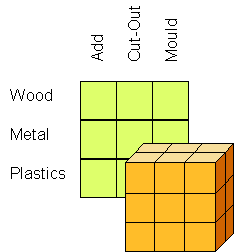
This is often a good way of forcing connections between variables. A three by three matrix can be created by listing specific materials and suitable processes. For example, if using resistant materials, this could be done by listing the materials wood, metal, plastics vertically and fabrication, reduction, forming horizontally. This could provide at least nine possible ways of making almost anything!
How would a particular part be made if it were formed using wood or cut out of solid plastics? Both lists can, of course, incorporate other D&T materials, or be extended to increase the choices - fabricated, reduced or formed from textiles perhaps. Sometimes just two variables are enough.
|
|
This matrices system can often be simplified and used effectively when teachers or examination boards require pupils to generate several solutions to a problem. Typically, a pupil is often reluctant to create further ideas after generating the first one, but where a teacher itemises the materials and/or processes, pupils can often be led into creating several meaningful ideas. For example, the teacher first encourages the pupil to create a single solution using mainly one material, or mainly one process. After the pupil has responded, the teacher can then request a second idea but using mainly a different material or process, and so on. Because the variables are different most pupils will respond and produce further ideas, from which some can be developed in detail later.
4. Analogous Solutions
It can often be useful to consider analogous or parallel solutions to the particular problem in question: eg consider stage lighting accessories when designing window blinds: look at fastening on clothing when designing closures for boxes; handles and hinges used in vehicles or mechanical fixings when designing furniture for the home.
5. Attributes List
The pen in your pocket might have a removable cap; a pocket clip moulded onto the cap; a long thin body based on a hexagonal prism; etc. Attributes such as these can be considered in terms of alternatives. For example:
6. Key Words
It is sometimes helpful to break the problem statement or theme down into its component parts and to consider each one in turn.
"Retrieval of Objects from Confined Spaces"
To help pupils organise their research, and to prepare them for any eventuality during the examination, the approach described was as follows:
7. Identifying Functions
A chair, for example, has the following functional aspects:
How these functional aspects are subsequently linked together to form a chair is then a matter of choice by the designer, by experimenting with rod, bar, strip, sheet materials, etc., and any combinations of them.
Items of clothing can be similarly separated into their distinct functional aspects, and many food products have specific functional nutritional requirements which relate directly to this approach.
Further reading:
All above publications are available from DATA, at the address below.
| |
Please send any comments on this Guideline to: Guideline@naaidt.org.uk
For a list of other NAAIDT publications see the Publications section or send s.a.e. to:
DATA, 16 Wellesbourne Road, Wellesbourne, Warwickshire CV35 9JB.
For more information on the work of the Association contact: Hon.Sec@naaidt.org.uk
| |
© NAAIDT March 1998
